1. Ask a countable question
Not "who is stronger" but "how many Tigers equal 200 Elephants?" The official example starts them at 500 vs 200 — your job is to find where that flips.
From your first battle to maximum-scale experiments: every guide is built on the game's documented facts and dated when checked.
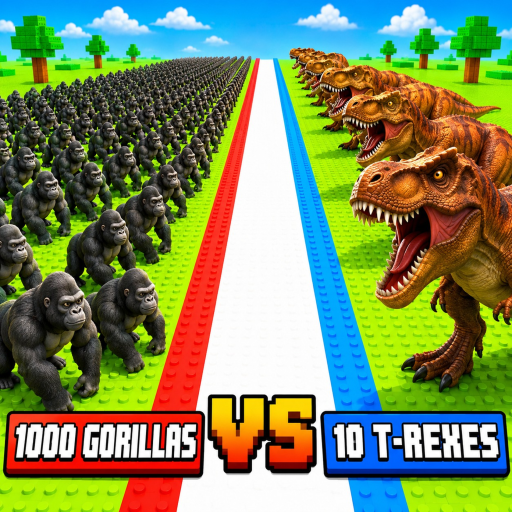
Who wins? is a physics battle sandbox by the verified World Simulation group, live on Roblox since July 21, 2026 and free to play. You pick creatures from a roster the official description puts at 100+, set how many of each side take the field, choose from different maps, and watch the armies collide under realistic physics — bodies shove, pile and trample instead of trading stat-sheet damage. The description's own examples set the tone: 1000 Mechs against 10 Kaijus, and 500 Tigers against 200 Elephants. There is no currency, shop, or code system documented; the one progression mechanic is collective — liking the game helps unlock bigger maximum battles. Since battles run in an instance of one player, every experiment is yours to design, and these guides teach you to design them well.
Facts from the official Roblox page and Roblox games API, checked 2026-10-03. 100–250 (varies by hour) concurrent players at the last check.
Start at the top if you are new; jump to the topic that matches your current experiment if you are not.
Walks your first session end to end: opening the battle builder, picking your first two creatures, setting counts you can actually read, and running the fight. Ends with the three mistakes new players make — stacking too many variables, judging a battle from one run, and skipping the map choice.
Your first 15 minutesLevel upThis sandbox has no XP bar, so progression means better experiments. This guide orders the skills: controlled one-variable tests, reading emergent physics behavior like piling and trampling, then scaling to bigger counts as the like-unlock system raises the ceiling.
Getting genuinely goodGet moreThe game's only documented reward is community-wide: likes unlock bigger maximum battles. This guide covers what you can actually accumulate — like milestones, a tested matchup notebook, and repeatable battle routines — and how to run a productive test session in a game with no grind bar.
Building toward bigger battlesScale upThe official description promises bigger battles for likes, and its own examples run from 500 vs 200 up to 1000 vs 10. This guide explains what scale changes — simulation load, readable outcomes, count ratios that stop being intuitive — and how to keep big experiments meaningful.
Maximum-scale testingUnderstandRealistic physics and total chaos are official description phrases, and they have practical consequences: bodies collide and pile instead of trading pooled damage, terrain matters, and outcomes carry variance. This guide translates the wording into how to run and read a fair fight.
Reading results correctlyAll five guides teach variations of the same core loop, so here it is once, using the game's own documented matchup.
Not "who is stronger" but "how many Tigers equal 200 Elephants?" The official example starts them at 500 vs 200 — your job is to find where that flips.
Keep the map, the creatures, and one side's count fixed. Move the other count by a meaningful step and rerun. One variable per battle is what makes results explainable.
Physics chaos means close fights repeat differently. Note each result — the squad planner makes a card of it — and replay near-draws before trusting the trend.
It is a single-player physics battle sandbox by the World Simulation group: you build armies from 100+ creatures, set the count on each side, and watch them fight on different maps. The developer's own examples are 1000 Mechs vs 10 Kaijus and 500 Tigers vs 200 Elephants.
The beginner guide. It covers your first battle from opening the builder to reading the result, and every other guide builds on that loop.
No code system and no currency are documented as of 2026-10-03 — the game is a sandbox, not a progression RPG. The farming guide covers the accumulation that does exist: like milestones toward bigger battles and your own notebook of tested matchups.
Yes — every number in these guides comes from the official Roblox page or Roblox's public API, each with its checked date (2026-10-03 at the latest full review). Where the game is undocumented, the guides say so instead of inventing values.
Each guide hands off to a tool that records or plans what it teaches.